
Biodiversity
 | |
|
Biodiversity
In biodiversity, the most common and straightforward misinterpretation is that it refers to a range of ecological benefits derived from a variety of lifeforms within a natural type. However, despite its simplicity, this interpretation can be downright misleading and even seriously incorrect. The reasons for the incorrect understanding of diversity in biodiversity are varied and often complicated. Still, the main one is that each habitat has its own limitations and advantages, which are definitely not suitable for interpreting as a host for foreign biodiversity. In reality, each unique habitat is often susceptible to the endemic species of its own prehistoric past, where the original Nature instead risk enduring biodiversity sensitivities, with direct limitations and vulnerabilities to external and incompatible biological interference, especially against biological life forms that are much more distant in evolutionary terms, spanning extended distances and prehistoric aeons.
Ethiopia's Unique Highland Environment:
Hosting a Toxic Foreign Threat
Although the Australian Eucalyptus tree is apparently growing without trouble in Ethiopia, it is not yet capable of exerting its vigorous dominance as an invasive species in the country, since biological incompatibilities originating from the remoteness of its DNA origin prevent a continental transpassing by sexual reproduction there; i.e., the seeds do not germinate in Ethiopian soils. Therefore, over the last century in Ethiopia, the standard practice for incorporating Eucalyptus trees has been manual field labour for seedling planting. In Ethiopia, the introduced Australian Eucalyptus trees soon began to dominate other vegetation due to their strategic outcompeting toxicity, enabling them to outcompete and suppress other trees. This toxic chemical component in the leaves and roots of Australian Eucalyptus trees counteracts and often completely inhibits the growth of the country's endemic trees and herbs. This Eucalyptus tree's aggressive toxins lead to monoculture, undermining biodiversity, since Eucalyptus is the only tree species. Eventually, the Australian Eucalyptus tree's toxic effects eradicated the country's endemic ground cover: the crucial food for the wildlife and the guardian against erosion.
The Ancient Creation Of The Ground's Biodiversity
With the Important Legacy of Native Trees
 |
| The symbiotic harmony within the biodiversity of the native plants' roots thereby counteracted the water resistance of the dense-packed ground and opened the soil's ability to stabilize porous permeability. This basic phenomenon between plants and soils allowed the water to pass through deeper soil layers and to reach aquifers. The Complex Sciences of Nature |
Thanks to the complex symbiotic biodiversity that developed during remote periods in the evolution of plants and ground-living organisms, they created and enabled the opening of the Earth's surface layers' permeability. Thus, these ancient organisms, along with their native plants, liberated the otherwise water-repellent soil surface and endowed the ground with water-absorbing properties. Hence, the indigenous forest is the main factor in its ability to saturate the aquifers, with a potent water-accumulation effect at the actual depth of the mountain massif's total configuration.
The Armoured Biodiversity from the Past
With the intricate heritage of guardian biology from the primaeval forest's water-assisting lushness, the native roots armoured the effects of erosion and microorganisms in symbiosis, preventing erosion and landslides caused by the otherwise brittle, fragile soils. Hence, with their intricately stabilizing fibrous roots, these plants, in ancient times, formed a symbiosis with the surrounding Earth's organisms and, at the beginning of time, initiated the flow of water through the soil and towards Earth's groundwater reservoirs.The Synergy of Precipitation, Geology, and Vegetation
The Landscape's Water and Unique Soils
These phenomena are interconnected, and the indigenous vegetation and biological structures are crucial for distributing rainwater to the aquifers and preventing erosion. Prehistorically in Ethiopia, the harmony among geology, water, plants, and soil enabled the landscape's mountain massifs and deeper soils to retain their natural capacity to securely harbour water, thereby providing irrigation and nourishment for large harvests. Hence, to assist modern analysis of this complex prehistoric phenomenon, a simple parable appears here: the body naturally harboured water, maintained in the mountains' native highland vegetation, primaeval forests, and aquifers, which, in their requirements for scientific analysis, correspond to the methods used for highly complex dam and reservoir constructions. Thus, these high-tech wonders of the modern world, whose high-tech wonders strangely correspond to the importance of the highland forests' role in the care-taking of deluges and irrigation to provide the precious water to the lower land and their civilisations.
A Global Heritage of Shortcomings in Scientific Research
The Devastating Threat from a Foreign Toxicity
Therefore, it is crucial to prioritize scientific research and practical measures to combat erosion, as torrential floods driven by toxic-induced, artificially slippery, low-friction ground can pose a significant threat. The harmful impact of foreign trees on Ethiopia's natural environment, such as the toxicity of artificially implanted Australian eucalyptus trees, highlights the need for careful investigation into the detrimental effects of incompatible substances and organisms that lead to soil degradation and erosion. Therefore, understanding the broad environmental spectrum within the natural sciences is crucial before introducing foreign species into a potentially vulnerable habitat, where history has proven the devastating consequences of erosion and malnutrition.
 |
Videos: Soil Erosion Demo Wikipedia: Regenerative Agriculture Pinterest: Erosion Prevention Ideas |
Natural forest areas with native undergrowth are crucial for conserving plant and animal species richness. This wild forest and scrub are also essential for creating and transferring clean groundwater within the underground aquifers of the natural mountain massifs. Naturally, there are critical advantages to preserving the natural forests on the mountain massifs. However, observing high alerts on foreign and invasive species and their incompatible heritage is crucial.
The Legacy of Vegetation and Its Soils
Crucial here are the ground and geological compounds that slowly filter this water, transforming it into more permanent groundwater in the deeper-lying rock massif. These considerations of the native Nature give rise to a beautiful picture of lifeforms that have optimized their genetic code through evolution.The Eucalyptus Tree: A Foreign Intruder
The Eucalyptus Tree: A Rejector of Precious Water
The Eucalyptus treacherously misleading demands for large quantities of water, regrettably, appear due to its destructive ability to reject deluges into torrential flash floods. Areas that were periodically wet and had flora adjusted to such conditions were drained due to the in-planted Eucalyptus trees' water-rejecting properties. Because of the Eucalyptus trees' toxic effects on local flora, the biodiversity of a eucalyptus plantation is extremely low; there appears to be a lack of plants that specialized insects and birds need. Also, when timber is continuously removed from indigenous trees in the area without fertilizer input, soil quality gradually declines, reducing the likelihood of reintroducing indigenous species.
[ The Eucalyptus Tree ]
An Incompatible Foreign Tree Species

The Eucalyptus Tree and Its Tactical Toxicity
A chemical component with an intricate competition-oriented toxic defence system in the leaves and roots of Eucalyptus trees prevents the growth of other trees and herbs. This chemical component leads to a monoculture with Eucalyptus as the only tree species and eventually no ground cover. This chemical component causes severe erosion, as evidenced by the water running through Addis during the rainy seasons. Due to these shortcomings in the Eucalyptus plantation's water-retention capacity, it cannot counterbalance the uneven distribution of rainfall.
Conclusion and Wonderful Solution
The stalk of the native Podocarpus tree's seed is considerably more significant in height at an early stage of its soil germination than the equivalent of the Juniper tree seed. Because the Podocarpus tree has the uniqueness of raising its appetizing greenery to the sensitively exposed height of its brittle stems, an excellent and traditional solution arises thanks to the sharp thorn defence of Rosa abyssinica.
The Eucalyptus Tree's Environmental Toxicity
A Massive Loss of Public Health and Drinking Water
A chemical component with an intricate competition-oriented toxic defence system in the leaves and roots of Eucalyptus trees counteracts the growth of other trees and herbs. This Eucalyptus tree's chemical components lead to wildlife starvation, water shortages, a monoculture of Eucalyptus as the only tree species, and eventually no ground cover. This chemical component causes severe erosion, as evidenced by the water running through Addis Ababa during the rainy seasons. Due to these shortcomings in the Eucalyptus plantation's water-retention capacity, it cannot counterbalance the uneven distribution of rainfall. The result is often torrential flooding and severe erosion in the downslope areas.
The Ecological Background of the Native Forest
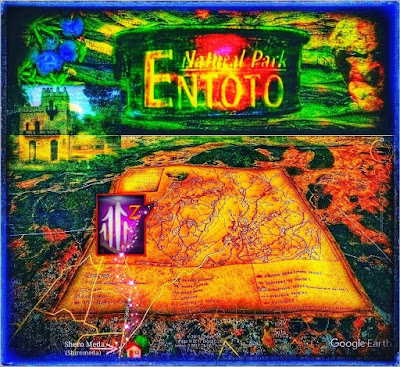
Find Indigenous trees using the Maps
 |
| Direction Map to the Alluring Past |
The Original Guardianship Of Trees and Soils
Thanks to the native trees, the Earth's surface layer's permeability was accomplished, allowing water to pass into the deeper soil layers and aquifers. Hence, the intricate biology within the ancient life forms optimized their DNA to distribute this water into the deeper layers of natural mountain areas. These native trees provided the ground, with its soils and deeper rocks, with a significantly increased and specified deposit of purified water to use during drought.
The Native Trees' Capacity to Distribute Water
Thanks to the evolutionary optimization of the highlands' ancient native trees' ecology, they evolved into formidable distributors of surface water to the aquifers, allowing it to penetrate the soil's otherwise porous, resistive structure. Thus, the native, ancient plants loosened the soil's otherwise dense fabric through their intricate root networks, allowing water to reach the aquifers.
The Guardian Forest from the Ancient Era
The healing capacity of a native forest
This original forest (40), just to the right of point (16), is captivatingly wild and features Juniperus procera trees more than 50 years old. This native woodland (40) offers a unique encounter with Nature, with a somewhat exotic, primaeval lushness and a great surprise. This native Juniper woodland (40) is massive in appearance and stunning in vitality, with a perfect, lush and dense undergrowth. This native forest's vibrancy and lushness are beyond what a visitor would usually expect in the vicinity of the Capital. The natural health and fertile beauty of this Indigenous Juniper forest (40) illuminate with precision the healing power of a native forest and the crucial Nature and habitat restoration that occurred to heal the toxic effect from the introduction of the Eucalyptus tree. The importance of careful research into the natural sciences is illustrated by a rigorous, evident example before any foreign species is considered for introduction into an unfamiliar and vulnerable habitat.
Nature Restoration and Cultural Origin
Environmental Devotion and Traditions
 |
| The Environment, Culture & Prosperity |
Environmental Work for Health and Prosperity
The indigenous Podocarpus falcatus (P. gracilior) is rare at Entoto, with only a few mature specimens, and it does not appear to produce seedlings among the nearby Eucalyptus. It seems that it is no longer feasible for it to propagate in the barren, eroded, exposed lands that have developed since the introduction of the alien Eucalyptus over a hundred years ago. However, the few ancient trees still produce seeds, where assistance may result in saplings for a protected reintroduction.
The indigenous Podocarpus falcatus (P. gracilior) is rare at Entoto, with only a few mature specimens, and it does not appear to produce seedlings among the nearby Eucalyptus. It seems that it is no longer feasible for it to propagate in the barren, eroded, exposed lands that have developed since the introduction of the alien Eucalyptus over a hundred years ago. However, the few ancient trees still produce seeds, where assistance may result in saplings for a protected reintroduction.
The Importance of Protection for Native Seedlings
However, much work has been done to reform the upper soil layer and establish a protective undergrowth. It would therefore be very pleasing to obtain information about a new generation of this highly blessed historic tree, which still grows in the magical, graceful and appealing landscape of Entoto Natural Park. To find these indigenous Podocarpus trees, use the area of the map loop (B).Entoto Natural Park's Natural Habitat
The Indigenous Nature of Water Health
The Park's 17 km² of mountainous terrain provides excellent variation in topography, humidity, climate, and soil. Given the unique conditions specified for each spot during planting and management, these considerations are crucial to the health of the indigenous vegetation. These analyses of topography's essential impact on the ground's and plant's stability and health constitute the primary source when estimating the restoration of the Park's ground and natural habitat. When designing with Nature, due care is essential to create habitats (biotopes) suited to the area's physical conditions. Juniperus procera is the natural species of Entoto, and it should dominate the future Natural Park. However, to preserve the natural health and diversity of plants, a specific species composition prevails as the primary factor in the Park's restoration, requiring a wide variety of species within the indigenous forest. (Håkan Blanck and Pia Englund, Entoto Natural Park 1995).
An Origin of Health and Prosperity
The Forgotten Cradle of Wealth & Beauty
 |
| The Native Podocarpus & Rosa abyssinica |
A Heritage from Times of Natural Wealth
This peculiarity in seed design, setting kernels to sprout beneath a protective shield of dense undergrowth, has its evolutionary origin in prehistoric lushness. This tree grows the young seed with a highly sensitive stalk. This way of raising the first greenery traces its origin to the beginning of these trees' (evolution) and to epochs long before any human culture or species.
A Nature with Ancient Guardianship
Through this evolutionary prehistory, these seed stalks and kernels were naturally received with moist, typically loose, absorbing soil (humus) and dense protective undergrowth that could hide and shield these tender, exposed, vertically raised kernel stalks.
The Importance of Indigenous Ethiopian Trees
The Primordial Forests' Shielding Armour

Podocarpus falcatus (P. gracilior)
Podocarpus falcatus (P. gracilior) 
This tree is scarce at Entoto and does not appear to compete with the Eucalyptus planted surroundings. It seems that it is no longer possible to give surviving progeny in the barren, eroded, exposed lands that have been formed since the introduction of the alien eucalyptus tree over a hundred years ago. However, much work has been done to reform the upper soil layer and establish a protective undergrowth. It would be a very significant surprise to receive news of a new, naturally germinated generation of this highly blessed historic tree, which still grows in a magical, graceful, and appealing landscape.
The Endemic Nature Restoration
Environmental restoration requires scientific research, time, and labour. It also demands massive protection projects to offer young plants a replacement for the lost biotope and its vital natural protective properties. Hence, restoring a lost biotope is complicated and requires significant effort to recreate a reliable substitute for the primaeval forest's missing shielding armour. Therefore, because the essential protective functions of mother trees and other plants are absent, enormous effort is required to recreate these guardian functions to shield the tender indigenous seedlings.
An Evolutionary Legacy from a Time of Natural Wealth
CAUTION: The Native Shielding Undergrowth
 |
| Entoto Natural Park (Nursery) Podocarpus falcatus |
A beautiful memory that attracts modern science and art
With glowing passion and warmth, it is still spoken of among the residents of Entoto that, for a reasonable time after the rainy season, the water level in Entoto's high-plateau streams and enchanting nature rock baths remained one metre higher. It is thus quite close to the time when Entoto's mountain massif and its canyons could carry significantly higher water quantity and, therefore, supply the population in the Capital with fresh water to a much greater extent. However, restoring an indigenous forest on a highland is difficult because the deep armour of endemic vegetation is absent. Therefore, human technology, such as gabions and mountain anchors, is often required.
Conclusion and Wonderful Solution
This small Podocarpus tree carries a unique heritage that can be very important for the Park's legacy. This tree's seed was picked from the mother tree in the circle (B), west of the path, left of the area (39) and clearly above (38). The stalk to the seed of this tree is considerably more significant in height than the equivalent of the Juniper tree seed. With this unique trait of raising their brittle stems, an excellent and traditional solution arises: Rosa abyssinica guards the seedlings thanks to the sharpness of its thorns.
The Science of Ancient Trees and Landscape
Biodiversity within the Genome of a Tree Species
The genetic legacy's impact across Ethiopia's various climates and altitudes results in trees that, although belonging to the same species, have developed distinct genetic adaptations to these different zones. Therefore, it's crucial to consider DNA's uniqueness when selecting the appropriate seed for a particular location. Thus, the mistake of using seed from a tree whose genetic origin is a moist, shady gorge as seedlings on a dry southern slope in the Ethiopian highlands undermines these trees' ability to survive, as well as that of other organisms, including humans.

Assessing Seeds after a Country's Climate Zones
Choosing the Right Mother Tree for Seed
The distant location, but within the same country, has developed fauna and flora that have undergone extremely long evolutionary optimisation to best adapt to the unique conditions of its geological and surrounding genetic characteristics. The unique habitat in a particular region within a country imparts distinctive properties to the indigenous trees, seeds, plants, and wildlife, depending on the region's remoteness and unique climate.
The Importance of Seed's Evolutionary Heritage
Hence, due to its isolated location on a country's exposed, dry mountainside or within its secluded gorge, the endemic tree has shaped the specificity of its genetic heritage and the uniqueness of its soil. Therefore, the trees' genetic background and evolutionary connection to a country's landscape create a precious legacy for their seeds, which inherit well-adapted traits suited to the location's biological uniqueness.
The Inheritance of Plants Depends on the Stimulus
From the Landscapes' Climate within a Country
 |
| The mistake of using the seed from a tree with genetic originating from a moist and shady gorge as seedlings on a dry southern slope undermines the trees' ability to survive and other organisms. However, this endures an intricate symbiotic phenomenon. Trees, Shrubs, Flowers and Herbs |
Trees' Origin from the Country's Terrain and Climate
Thus, distant locations within a country's topography and geography, yet within the same country's borders, have developed flora and fauna that have undergone an extremely long evolutionary process to best adapt to the unique conditions of their geological surroundings. Therefore, depending on the region's unique climate, the area's specific habitat within a country has shaped the native indigenous organisms, whose distinctive properties arise from close harmony with the soil types that have developed over aeons of Nature's obvious composting process, including mineral-sediment mixtures. Hence, this country's topographically isolated location endows organisms with distinct genetic properties due to the unique climatic conditions across its landscape.
Landscapes Give the Origin to Plants and People
Therefore, whether on the sun-blasted slope or within its secluded canyon, the endemic tree has developed a distinct genetic heritage that reflects the unique climate of the landscape. Thus, the trees' evolutionary connection to a country's landscape creates a precious legacy for their seeds, which inherit well-adapted genetic traits from their tree lineage, suited to the location's climate and topography. This background of diversity in stimulus activation also includes humans, as their health and ability to work are highly dependent on the uniqueness of their natural genetic heritage, whose well-being requires a corresponding stimulus from their culture.
Humanity's Culture and the Environment
.jpg) |
| With glowing passion and warmth, it is still spoken among the residents of Entoto about when the water level a long time after the rainy season still stood one metre higher in Entoto's canyon streams and its enchanting Nature. The History of the Environment |
The History of the Environment
The prosperity of civilisations across different cultures and parts of the World indicates an evident connection between in-depth knowledge of biology and a culture's potential for development. A healthy relationship is apparent in this rule, even in other sciences. Still, it is particularly evident in biology, as it is so closely related to human health and well-being.
Alerts: Humanity and the Environment
However, the insidious hierarchical governing terror of the past caused severe scares among many nations, inflicting humiliation in severe starvation and fearful aversions, thus damaging the population's most critical needs for safe stimulus in daily life and duties.
Secrets From a Time Lost in Shadows and Turmoil
A Forgotten and Forbidden Historical Past
 |
The Artworks: Leonardo da Vinci |
Personal Stimulating: A Risky Journey in Life?
A Humanity Subconsciously Behind Bars
However, behind the bars of humankind's cage, made of fabricated obstacles and ingrained social norms, there prevails nothing more than a culturally enforced inheritance that most individuals must live within. Thus, throughout history, humankind's civilizations have often endured long periods of psychological and physiological torment in cycles of repeating cataclysmic paradigms, and personal experiences of corrosive agony about what is wrong, where they usually never find the natural source of their discomfort or its underlying cause.
Biodiversity in the Human Genome:A Delicate and Complex TopicBiodiversity is often emphasized as being of great importance for maintaining the survival potential of different species, enabling them to overcome difficult environmental challenges or dangerous infectious agents. In humans, this biodiversity also aligns with scientific consensus, as it repeatedly demonstrates its impact on the global population. However, when it comes to humans, this background on the benefits of evolutionary biodiversity is insufficient and often seriously misleading. The reason for these misleading results from human biodiversity is the overwhelming contradictions between evolution through DNA in natural selection and evolution through DNA in cultural selection. Thus, humans' great ability to shape and dominate the natural environment can, in many circumstances, overwhelm their inherited DNA predispositions, which lie in the ancient origins of the species Homo sapiens sapiens and its substantial legacy from its predecessors, shaped by severe natural conditions. When considering the phenomenon of the Y-chromosome bottleneck in humans, the importance of enduring biodiversity, for example, becomes misleading and even contradictory, as the human species demonstrates its enormous capacity to use its cultural behaviour to deselect genetic traits that the environment had previously prioritised during human evolution.
Biodiversity in the Human Genome:
A Delicate and Complex Topic
Biodiversity is often emphasized as being of great importance for maintaining the survival potential of different species, enabling them to overcome difficult environmental challenges or dangerous infectious agents. In humans, this biodiversity also aligns with scientific consensus, as it repeatedly demonstrates its impact on the global population. However, when it comes to humans, this background on the benefits of evolutionary biodiversity is insufficient and often seriously misleading. The reason for these misleading results from human biodiversity is the overwhelming contradictions between evolution through DNA in natural selection and evolution through DNA in cultural selection. Thus, humans' great ability to shape and dominate the natural environment can, in many circumstances, overwhelm their inherited DNA predispositions, which lie in the ancient origins of the species Homo sapiens sapiens and its substantial legacy from its predecessors, shaped by severe natural conditions. When considering the phenomenon of the Y-chromosome bottleneck in humans, the importance of enduring biodiversity, for example, becomes misleading and even contradictory, as the human species demonstrates its enormous capacity to use its cultural behaviour to deselect genetic traits that the environment had previously prioritised during human evolution.
 |
Fasilides Bath, Gondar, Ethiopia. 📸: From Wikimedia Commons. |
A Classic Castle at the Spring Sources
Historical Influences for Restoration
Common check dams offer an opportunity to recreate an environment that is almost ideally suited to people and Nature. For example, placing a building like Fasilides Bath next to a stream on the high plateau would provide Nature with a fantastic water supply. However, in contrast to the water technology of check dams in ordinary, historic buildings, like Fasilides Bath in the picture to the right, would serve as a water contribution to the surrounding landscape, while also enhancing the attraction's capacity as the most beautiful location for facilities. With dramatically classic architecture, this magnificent Castle lodge with a restaurant overlooking the water entices fantasies and dreams in the cosiest, hiking-friendly surroundings. Within the mystique and wilderness of primordial Nature, the Castle offers accommodation with adventure and grace.
Plant Defence Against Herbivory
 |
| Trees, Shrubs, Flowers and Herbs |
Erosion Prevention Ideas: https://www.pinterest.com/entoto0351/_saved/
The Science of Indigenous Ancient Trees:
The World's Heritage:
A Delicate and Precious Legacy of SymbiosisHence, Nature's organic protective and shielding mechanism of the native plants, executed in old times, preserved their natural character, thus protecting them and saving this precious water for an unknown dry season in the coming years.
Erosion Prevention Ideas: https://www.pinterest.com/entoto0351/_saved/
___________________________________________________________________________________
.jpg)
Plant a tree with Inside Ethiopia Tours
Inside Ethiopia, Tours invites you to be part of an unforgettable experience in Entoto Natural Park. We will meet in our office, located in Kazanchis (just in front of the UNECA back entrance), and our guide will accompany you in the local taxis up to the mountain. This is an excellent opportunity for you to experience Ethiopian commuting.
Once we arrive on Entoto Mountain, where the capital city was first founded in 1886, you will undoubtedly feel like having mentholated topical ointment. Yes, we are not big fans of the Eucalyptus tree either! That is why we want to promote indigenous seedling planting in Ethiopia by contributing to the Ethiopian Green Legacy.
Inside Ethiopia, Tours invites you to be part of an unforgettable experience in Entoto Natural Park. We will meet in our office, located in Kazanchis (just in front of the UNECA back entrance), and our guide will accompany you in the local taxis up to the mountain. This is an excellent opportunity for you to experience Ethiopian commuting.
Once we arrive on Entoto Mountain, where the capital city was first founded in 1886, you will undoubtedly feel like having mentholated topical ointment. Yes, we are not big fans of the Eucalyptus tree either! That is why we want to promote indigenous seedling planting in Ethiopia by contributing to the Ethiopian Green Legacy.
Where do you plan to make your mark?
The Ethiopian Heritage Trustee Association is working to plant more than 50,000 indigenous saplings in Entoto Natural Park and Zego Kebele Association in Ankober District to cover exposed areas. Organizations: Associations: Educational institutions: All those who love Nature, together with our association, let's build a country with suitable air by planting saplings. Let's plant indigenous saplings together.
As we believe, we are ready and waiting for you this year. The Ethiopian Heritage Trustee Association has planted native saplings in place of Eucalyptus trees with partner organizations and members in the Entoto Natural Park. He tells you that this year, come and plant saplings together to protect the environment. For more information:
📞 Call +251 Ethiopia
011-5-15-88-02/ 09-22-97-27-46
Ethiopian Heritage Trust - Plantation of Seedlings
_______________________________________________________________________
_______________________________________________________________________
 |
Identification, Propagation and
Management for 17 Agroclimatic Zones
Azene Bekele-Tesemma
Edited byBo Tengnäs, Ensermu Kelbesa, Sebsibe Demissew and Patrick Maundu
The contents of this handbook may be reproduced without special permission. However, acknowledgement of the source is requested. The photographers and artists concerned must be contacted for reproduction of illustrations. The views expressed in this publication are those of the authors and do not necessarily reflect the views of World Agroforestry Centre.
Edited by
Bo Tengnäs, Ensermu Kelbesa, Sebsibe Demissew and Patrick Maundu
The contents of this handbook may be reproduced without special permission. However, acknowledgement of the source is requested. The photographers and artists concerned must be contacted for reproduction of illustrations. The views expressed in this publication are those of the authors and do not necessarily reflect the views of World Agroforestry Centre.


Comments
Post a Comment